Desi Murgi vs Broiler: Taste, Nutrition, Price and Which to Cook
Desi murgi vs broiler compared honestly: growth time, taste and texture, nutrition, price per kg of real meat, and which bird suits karahi or yakhni.
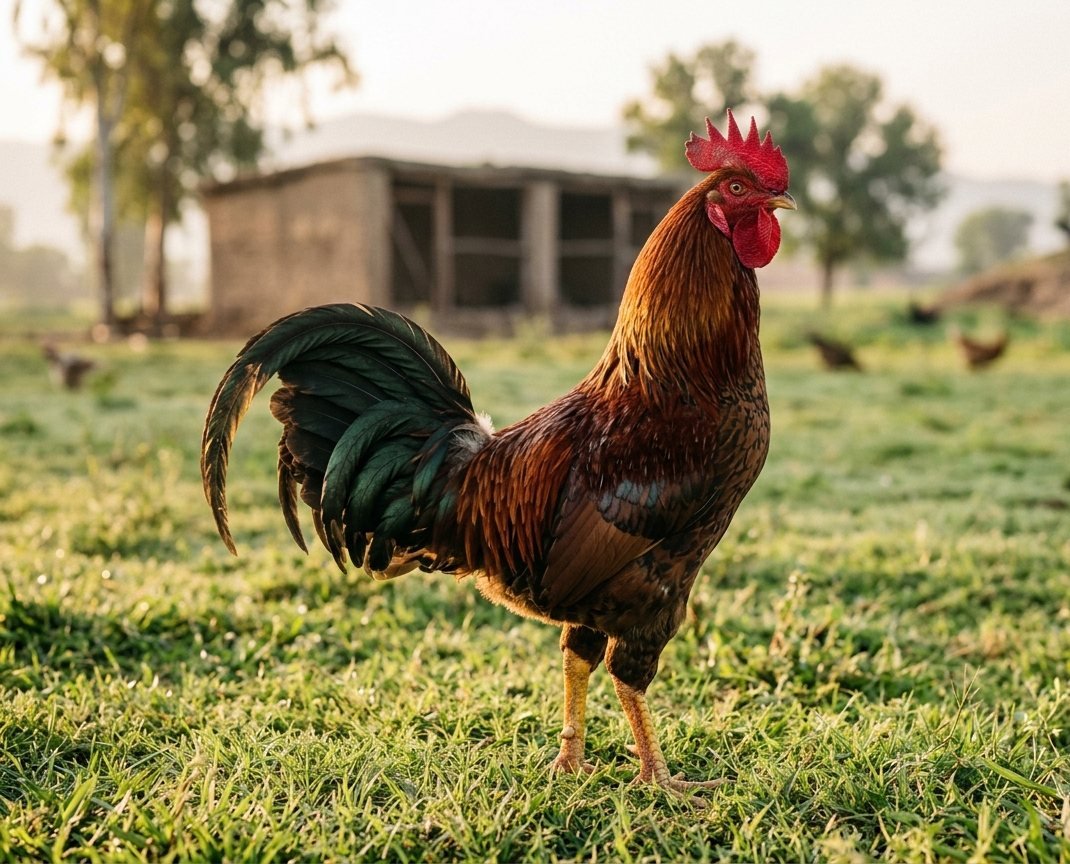
A broiler is a fast-growing bird slaughtered at about 6 weeks old; a desi murgi is a slow-growing country bird slaughtered at 4–6 months. That age gap is almost the whole story: broiler meat is soft, pale and mild and suits quick cooking, while desi meat is firmer, darker and stronger in flavour, costs roughly two to three times as much per kilogram, and needs long, slow cooking to be worth eating. Neither is simply better — they are different ingredients for different dishes.
Why does a broiler grow in 6 weeks and a desi murgi take 6 months?
A broiler reaches slaughter weight in about 6 weeks. A desi cockerel takes 4–6 months to reach a smaller size — roughly four times as long for perhaps two-thirds of the bird. This is not because the broiler is fed anything sinister; it is mostly genetics. Broiler strains are the result of decades of selective breeding for one trait above all others: fast, efficient growth. A modern broiler converts somewhere around 1.6–1.8 kg of feed into a kilogram of live weight, and it does most of its short life sitting near a feeder, because sitting and eating is what it was bred to do.
Desi birds are the opposite case. They are country breeds and their crosses, never selected for growth rate. Given outdoor space, a desi bird spends its day walking, scratching and foraging, and it puts its energy into bone, feathers and maturity rather than breast muscle. The result is a bird that takes months to finish and never gets big. That slowness is also exactly where the taste comes from.
What does age actually do to taste and texture?
Meat is muscle, and muscle changes with age and use. A 6-week-old broiler has fine young muscle fibres, very little myoglobin — the pigment that makes meat dark — and immature connective tissue. That is why broiler meat is pale, soft and mild: pleasant enough, but mostly a carrier for the masala.
A five-month-old desi cockerel has spent those months walking. Its muscle fibres are thicker, its legs and thighs are darker with myoglobin, and its connective tissue — collagen — is well developed. Cooked fast, that collagen makes the meat tough. Cooked slowly, it melts into gelatine, which is what gives a desi karahi its faint stickiness on the lips and a yakhni its body. The flavour is also simply stronger: older muscle, darker meat and a varied diet of greens and insects produce a deeper, slightly gamey taste that a 6-week-old bird cannot have, whatever it is fed.
Which bird suits which dish?
The honest rule is to match the bird to the pot time.
- Desi cockerel — karahi, bhuna dishes and slow-cooked saalan. It needs a long gentle simmer before the final bhuno; the reward is meat that holds its shape and tastes of something on its own.
- Older desi hen — yakhni, shorba and stock. An older bird’s collagen-rich carcass gives a broth that sets to a soft jelly when cold; that jelly is gelatine, and it is the entire point of a yakhni. A broiler carcass makes a thin broth by comparison.
- Broiler — everything quick. A 30-minute karahi, boneless handi, tikka and boti on the grill, fried chicken, the everyday saalan on a weeknight. For these dishes a broiler is honestly fine, and a desi bird would not improve them enough to justify its price.
The mistakes run both ways. Put a desi bird into a 25-minute recipe and it comes out tough, and the buyer wrongly blames the bird. Simmer a broiler for two hours and it collapses off the bone into strings while the broth stays thin. Neither result means the bird was bad; it means the bird and the dish were mismatched.
Is desi murgi more nutritious than broiler?
Less than the price gap implies. Studies comparing indigenous chicken with commercial broiler generally find desi meat somewhat leaner, slightly higher in protein per 100 grams, and firmer in fibre, with a little less fat under the skin. Differences in vitamins and minerals show up in some studies and not in others, and where they appear they are modest. How the bird is cooked — skin on or off, how much oil goes in the pan — moves the nutrition numbers more than which bird it was.
This mirrors what happens with eggs, where real but modest differences get inflated into health claims — covered separately in desi eggs vs farm eggs. Paying two to three times more per kilogram for nutrition alone is hard to justify, and it would be dishonest to pretend otherwise. Texture and flavour, not vitamins, are what desi murgi is for. If the budget is tight and the dish is quick, the broiler is honestly fine.
The price maths per kilogram of actual meat
In Islamabad, dressed broiler commonly sells somewhere in the range of Rs 700–900 per kilogram, moving week to week with feed prices. Genuine desi murgi typically costs two to three times that per kilogram. The gap is not showmanship; it is arithmetic. One bird eats for 6 weeks, the other eats for 4–6 months, and the slow bird also finishes smaller: a desi cockerel usually dresses at a little over a kilogram, where a broiler dresses at 1.5 kg or more. Feeding a bird three times longer to get a smaller carcass has to show up in the price.
The per-kilogram sticker also understates one thing and overstates another. It understates the broiler’s cost because fast-grown meat loses more water in the pan — studies generally find higher cooking loss in broiler meat — so a kilogram of raw broiler shrinks to less cooked meat than a kilogram of raw desi. It overstates the desi bird’s value because a desi carcass carries a higher share of bone and less breast meat, so a kilogram of it holds a bit less boneless meat. The two effects partly cancel out. After all the maths, desi still costs clearly more per cooked gram; there is no calculation that makes it the economical choice. What the money buys is time, and time only shows in the dishes built on it.
What is the “desi murgi” in the market, really?
Here is the part nobody in the trade says plainly: much of what is sold as desi in city poultry shops is not a village-raised desi bird. It is usually one of two things — a farmed dual-purpose crossbreed (Golden, Misri and similar strains, raised in sheds and sold under the desi name) or a spent layer, meaning a commercial egg-laying hen sold for meat at the end of her laying life. Pakistan has no enforced labelling standard for chicken, just as “organic” on an egg carton here is a claim rather than an audited standard — the word desi at a poultry shop is a claim too.
A few practical checks at the shop:
- Size and shape. A genuine desi cockerel is small and lean — long slim legs, a narrow breast, dark firm thigh meat and very little fat. A carcass approaching broiler size that is labelled desi deserves questions.
- Fat. A spent layer carries pads of soft yellowish fat inside the cavity; a young desi bird has almost none.
- Skin and shanks. A bird that has walked for months has firmer skin and hard, worn shanks. Shed-raised birds have smooth, soft ones.
- Ask the age. A seller with a real desi bird knows roughly how old it is, because raising it took months of feed. Hesitation is also an answer.
How long should each bird cook?
| Bird | Suits | Open pot | Pressure cooker |
|---|---|---|---|
| Broiler (about 6 weeks old) | Quick karahi, handi, barbecue, everyday saalan | 25–35 minutes | Not needed |
| Desi cockerel (4–6 months) | Karahi, bhuna, slow saalan | 60–90 minutes at a gentle simmer, then bhuno | 15–20 minutes, then finish on open flame |
| Yakhni hen (older bird) | Yakhni, shorba, stock | 2–3 hours at a bare simmer | 35–45 minutes |
Two habits make the difference with a desi bird. Keep the liquid at a lazy simmer rather than a rolling boil — hard boiling tightens the fibres and undoes the tenderness the long cooking is meant to build. And judge doneness by feel, not by the clock alone: birds vary with age, and a fork should slide into the thigh with only mild resistance before the final bhuno.
For what it is worth, this is the bird we raise. Our whole desi chicken is a flat Rs 2,650 per dressed bird — a karahi cockerel or a yakhni hen, any cut — hand-slaughtered halal to order and delivered chilled across Islamabad and Rawalpindi. How the birds are raised, and how slowly, is on the farm page.
The short version for the kitchen: if the pot time is under 40 minutes, buy a broiler without any guilt. If the dish is built on time — a karahi that simmers, a yakhni that barely moves for two hours — a genuine desi bird repays what it costs. And whichever you buy, ask what the word desi means at that particular counter, because at the moment it can mean almost anything.
Try them yourself
Six-egg trial pack, Rs 300, delivered anywhere in Islamabad or Rawalpindi.