Desi Anday Price in Islamabad and Rawalpindi: The 2026 Guide
Desi anday price in Islamabad and Rawalpindi, 2026: real free-range desi eggs cost Rs 600-750 a dozen. Why the gap exists, and how sellers fake desi.
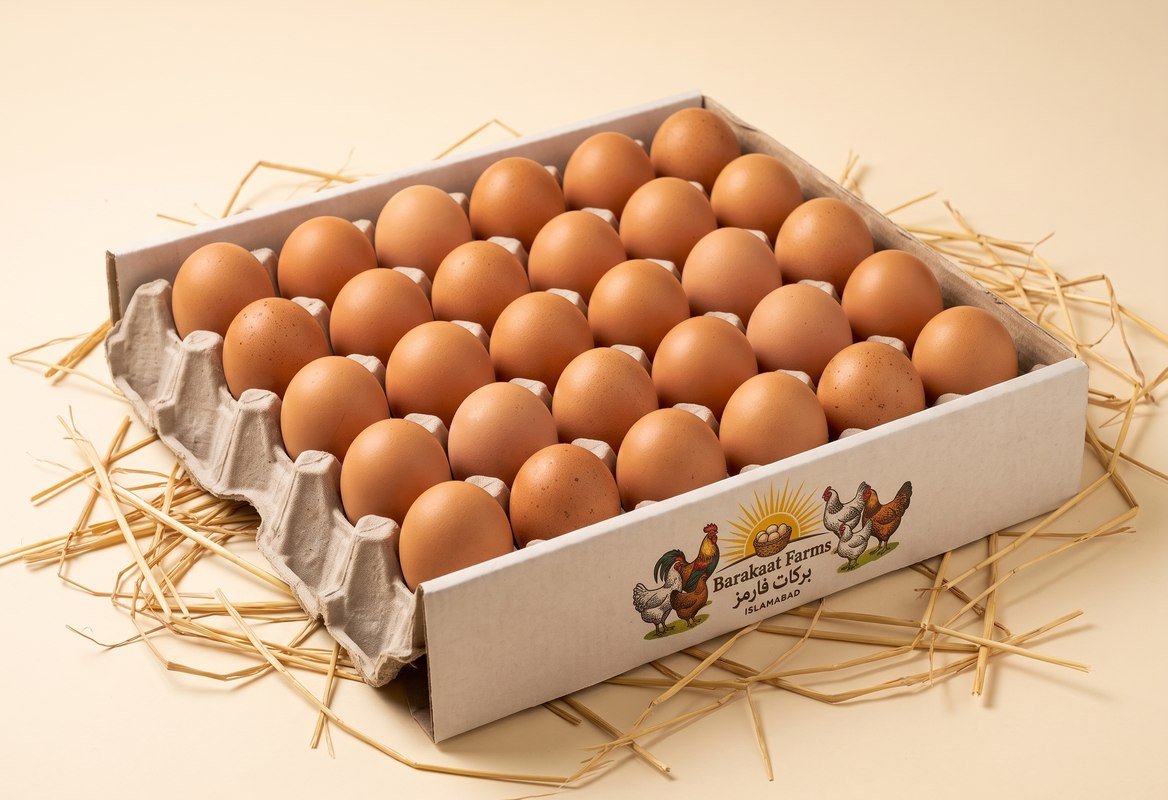
In 2026, genuine free-range desi anday sell for Rs 600–750 a dozen from farms in and around Islamabad and Rawalpindi. That compares with roughly Rs 250–300 a dozen for white commercial eggs and around Rs 400 for brown commercial eggs — so real desi anday cost at least twice what ordinary eggs do. A full tray of 30 desi eggs runs from about Rs 1,450 to Rs 1,850 depending on the farm.
Those three numbers do most of the work in this guide. The rest of it explains why the gap exists, how some sellers close the gap dishonestly, and why the price on the carton is itself one of the more reliable clues about what is inside it.
What do desi anday cost in Islamabad and Rawalpindi in 2026?
The table below shows the going retail rates across the twin cities. The ranges are wide because sellers differ in flock size, feed, and whether delivery is built into the price.
| Egg type | Per dozen | Per tray of 30 (approx.) |
|---|---|---|
| White commercial | Rs 250–300 | Rs 600–750 |
| Brown commercial | around Rs 400 | around Rs 1,000 |
| Free-range desi | Rs 600–750 | Rs 1,450–1,850 |
The tray figures are mostly straight arithmetic — a tray of 30 is two and a half dozen — with a small discount at the bottom of each range, because most sellers shave something off for bulk. Notice what the table does not show: a legitimate middle band. An egg comes either from a caged commercial layer or from a bird that actually ranges, and “semi-desi” at Rs 450 a dozen is a marketing category, not a farming one. Desi-cross birds do exist, but if they genuinely live outdoors, the economics below push their eggs into the same Rs 600-plus band as everything else that does.
Why do real desi anday cost twice as much?
The price gap is not branding. It is a yield gap. A desi or desi-cross hen with outdoor access lays roughly 140–180 eggs a year. A caged commercial layer — a bird bred over decades for exactly one job — lays close to 300. Every cost the farm carries, from feed to land to labour, is therefore spread across roughly half as many eggs. Halve the output and you have already doubled the cost per egg before anything else is counted.
And other costs do stack on top of that arithmetic:
- Space. Free-range birds need ground to range on. A commercial shed drives its cost per egg down through density; an open run cannot, because the whole point of it is that the birds are not packed in.
- Feed that goes further than the egg. A ranging bird spends energy walking, scratching and foraging, and desi breeds convert feed into eggs less efficiently than commercial hybrids were designed to.
- Losses. Birds that live outdoors face predators, weather and ordinary misadventure in a way caged birds never do. Farms that keep hens outside generally accept higher losses as part of the model.
Run the numbers in either direction and Rs 600–750 a dozen is not a premium so much as a floor — close to the least a farm can charge and still make sense of keeping free-range desi hens at all. Which raises the obvious question of how anyone manages to sell “desi anday” for less.
How do sellers pass off ordinary eggs as desi anday?
The most common trick is the simplest: brown commercial eggs sold as desi. Shell colour is determined by the breed of the hen and nothing else — a brown shell says nothing about diet, outdoor access or breed heritage. Brown commercial eggs retail around Rs 400 a dozen; call them “desi”, charge Rs 650, and the extra Rs 250 appears out of thin air. The full shell-colour story, along with the other differences that actually matter, is in Desi Eggs vs Farm Eggs.
Yolk colour is the second trick. Commercial feed often includes pigments — marigold extract, canthaxanthin — that darken yolks to the deep orange buyers associate with desi anday. A dark yolk can be bought by the sack, so on its own it proves nothing.
The third is the word “organic”. Pakistan has no enforced organic poultry certification, so “organic” on an egg carton here is a claim, not an audited standard. Any seller can print it. What the word does and does not mean — and the questions worth asking anyone who uses it — is covered in What “Organic Eggs” Really Means in Pakistan.
What does a fair price signal — and what does a cheap one?
Given the lay-rate arithmetic above, the prices you will actually be quoted in the twin cities sort themselves into rough bands:
- Rs 250–400 a dozen: commercial eggs, white or brown, honestly priced. There is nothing wrong with them as food.
- Rs 400–550 sold as “desi”: treat with suspicion. At this price the seller is either losing money on every dozen or — far more likely — selling brown commercial eggs with a better story attached.
- Rs 600–750: the plausible band for genuine free-range desi anday in 2026. This is where the economics land.
- Above Rs 800: possible, but a high price is not proof of anything either. Sometimes it reflects small supply; sometimes it only reflects nicer packaging.
In short: a cheap “desi” egg is a red flag, and an expensive one is not a guarantee. Price can rule an egg out, but it cannot rule one in. To rule in, look at the eggs themselves — the note above is the quickest test — ask where the birds range, and ask whether you can visit the farm. A seller with real free-range birds usually has no reason to refuse.
Where do Barakaat Farms prices sit?
Since this is our guide, it is only fair to state our own prices plainly and let you hold them against the bands above. We sell desi anday at Rs 600 a dozen and Rs 1,450 for a tray of 30 — the bottom of the genuine band, with the tray working out to about Rs 580 a dozen. A trial pack of 6 is Rs 300, two dozen is Rs 1,200, and a weekly subscription runs at the same unit rates from Rs 2,400 a month (how the subscription works). Delivery across Islamabad and Rawalpindi is Rs 350 flat, free on orders over Rs 3,500, and same-day when the order is placed before noon (coverage areas here); pickup from the farm is free. The current full list, eggs and whole desi chicken both, is on the price page.
One admission that costs us sales: if you mostly hard-boil eggs in bulk, or bake with them, commercial eggs at Rs 250–300 a dozen are honestly fine, and most of what you are paying for in a desi egg will be lost in the cake. Desi anday earn their price where the egg is the dish — fried, half-fried, a plain omelette — and where how the hen lived matters to you.
Do desi anday prices change through the year?
Generally, yes. Egg demand across Pakistan rises in winter, and free-range flocks tend to lay less in both the coldest and the hottest stretches of the year — daylight hours and heat both affect birds that live outdoors. Commercial sheds smooth this out with controlled lighting and cooling, which is why white egg prices swing with the season while genuine desi supply tightens at exactly the moment winter demand peaks. Expect quotes at the top of the Rs 600–750 band in December and January, and expect some small farms simply to run out rather than stretch what their hens lay.
Whichever month you buy in and whoever you buy from, the price only tells you whether an egg is likely to be desi — not whether it is fresh. That is a separate check, it takes a glass of water and about ten seconds, and it is covered in How to Tell if an Egg Is Fresh.
Try them yourself
Six-egg trial pack, Rs 300, delivered anywhere in Islamabad or Rawalpindi.