Free-Range Eggs: What the Term Actually Means, and What It Does Not
Free range eggs meaning explained: what cage, cage-free, free-range and pastured really mean, why Pakistan enforces none of these labels, and how to check one.
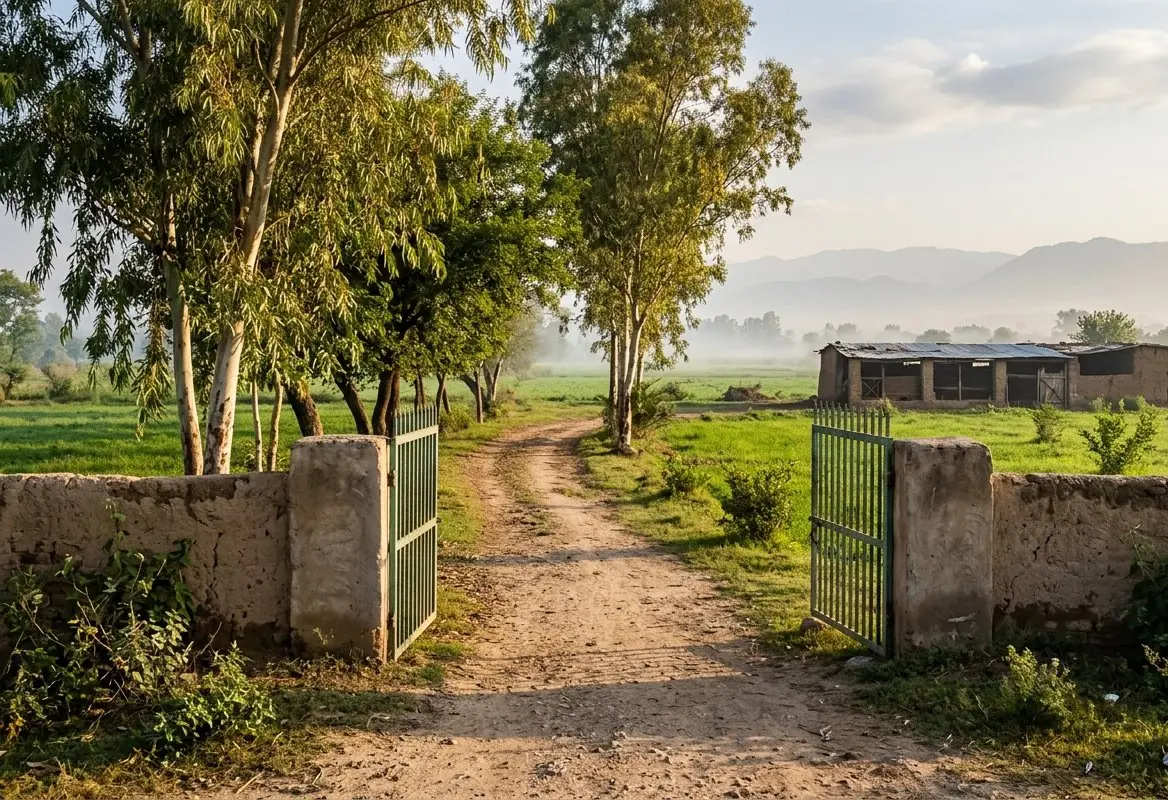
Free-range means the hens live uncaged in a shed or coop and have regular access to an outdoor area during daylight hours. It describes a housing system — how a hen lives — not her breed, her feed, or the nutritional content of her eggs. In Pakistan no authority inspects or enforces the term, so on a local carton “free-range” is a claim the seller is making, not a standard anyone has audited.
What do cage, cage-free, free-range and pastured actually mean?
Egg labels around the world describe four broad housing systems. The words are often used loosely in Pakistan, so it is worth knowing what each one is supposed to mean before deciding whether a carton deserves the price on it.
Cage, or battery. Hens live in wire cages stacked in rows inside a climate-controlled shed, several birds to a cage, each with a floor space typically smaller than a sheet of A4 paper. The birds never go outside. This is how the overwhelming majority of commercial white eggs in Pakistan are produced, and it is the reason they are cheap — roughly Rs 250–300 a dozen retail at the moment.
Barn, or cage-free. No cages: hens move freely inside a shed, usually with perches and litter on the floor. Cage-free sounds generous but requires no outdoor access at all. A cage-free hen can live her whole life under a roof.
Free-range. A barn system plus outdoor access — openings in the shed wall let the hens out onto open ground during the day. How much ground, and for how many hours, is exactly what proper regulation defines and Pakistan does not.
Pastured. The birds live primarily outdoors on grass or open ground, often with movable shelters, and forage for part of their diet. It is the smallest-scale and most labour-heavy system, and the one closest to how village poultry has always been kept here.
| System | Housing | Outdoor access | Typical lay rate |
|---|---|---|---|
| Cage (battery) | Stacked wire cages indoors | None | Close to 300 eggs a year from a commercial layer |
| Barn (cage-free) | Loose inside a shed | None required | Commercial breeds, generally slightly below caged rates |
| Free-range | Shed with openings to open ground | Daytime access outdoors | Depends on breed — a desi hen on range lays roughly 140–180 a year |
| Pastured | Mostly outdoors, movable shelter | Constant | Generally the lowest, varying with season and forage |
Notice that the lay rate column is mostly about breed, not housing. A commercial hybrid layer produces close to 300 eggs a year wherever she lives; a free-range desi hen manages roughly 140–180, under half as many. That gap, more than the land or the labour, is why genuinely free-range desi eggs cost what they do.
Is “free-range” on a Pakistani carton regulated?
No. In the UK and the EU, free-range is a legal definition: it specifies stocking density, continuous daytime access to open runs, and it is inspected, with penalties for misuse. Pakistan has no equivalent for retail eggs. No federal or provincial authority defines the term, audits farms against it, or penalises a seller who prints it on a carton of ordinary barn or even caged eggs.
This is the same situation as “organic,” which we have written about separately in our article on organic eggs in Pakistan: the word is legal to use and impossible to verify from the label alone. That does not make every seller using it dishonest — many free-range claims here are true. It means the label is the beginning of the question, not the answer to it.
What does free-range actually change about the egg?
Less than the marketing implies, and more than a cynic would admit. On nutrition, the honest answer is: modestly. Eggs from hens that genuinely forage outdoors are generally reported to carry somewhat more of certain nutrients — omega-3 fats and vitamin D among them — because of the varied diet and the sunlight. The differences are real but modest; a free-range egg is still an egg, not a supplement.
Yolk colour deserves its own correction, because it is the most common false test. A deep orange yolk comes from pigments in the hen’s diet — greens, maize, marigold and similar — not from her freedom. A caged hen fed pigmented commercial feed will lay a dark-yolked egg; a genuinely free-ranging hen on dusty winter ground can lay a pale one. Yolk colour tells you what the hen ate, not how she lived. We have covered this and other unreliable tests in how to identify real desi eggs.
The two differences that hold up are welfare and eating quality. A hen that can walk, scratch, dust-bathe and perch is simply living a less miserable life than one in a cage, and for many buyers that is reason enough. On the plate, eggs from foraging hens typically taste richer and fry with a firmer white, though taste is partly habit and nobody should pretend it is a laboratory measurement. What free-range does not change: freshness, shell colour, and safety, which depend on handling and time, not housing.
What does free-range not mean?
Free-range describes how a hen lives, not what breed she is. This is the claim worth stating plainly, because the two ideas are constantly blurred in Pakistani listings. A commercial hybrid layer — the same white or brown bird that fills battery sheds — can be raised free-range, and her eggs are honestly free-range while being nothing like desi eggs. Equally, a desi hen locked in a small cage would lay desi eggs that are not free-range. Breed and housing are separate facts, and a careful seller states both. The breed side of the question is covered in desi eggs vs farm eggs.
- Free-range is not organic. Organic concerns feed and medication rules; a free-range hen can eat ordinary commercial feed. Neither term is enforced here.
- Free-range is not desi. Range access does not change a bird’s breed.
- Free-range is not a yolk-colour guarantee. Pigment comes from feed, caged or not.
- Free-range is not fresher. A week-old free-range egg is older than yesterday’s caged one.
How do you check a free-range claim in Islamabad or Rawalpindi?
Two questions do more work than any label, and neither requires expertise.
- Can you see the birds? A farm whose hens genuinely range will let you visit, or at least show ordinary, unstaged photos and video of birds on open ground. In a country with no certification, the only real proof of free-range is a gate you can walk through. A seller who will not show the birds is asking you to buy the word instead.
- Does the seller say how many hens they keep? Flock size caps honest supply. At roughly 140–180 eggs a year, a desi hen on range gives perhaps three eggs a week; a hundred hens cannot honestly supply much more than two dozen trays a month. A seller offering unlimited free-range desi eggs year-round, with no stated flock size, is doing arithmetic that does not work.
Price is the rough third check. In the Islamabad listings we could check, free-range desi eggs run about Rs 600–700 a dozen, against roughly Rs 250–300 for commercial white — the current spread is laid out in our desi eggs price guide. A “free-range” carton priced like battery eggs is almost certainly mislabelled, because the lay-rate gap alone makes that price impossible to sustain.
Our own answer to the two questions is short. Farm pickup is free, and anyone collecting eggs can see the flock and the ground it ranges on — the farm page shows where we are. We would rather a buyer apply these tests to us than take the word on any carton, ours included.
Try them yourself
Six-egg trial pack, Rs 300, delivered anywhere in Islamabad or Rawalpindi.