How to Identify Real Desi Eggs: 7 Checks That Actually Help
How to identify real desi eggs: 7 checks that help, the myths that do not, how tea-dyed shells are made, and why no kitchen test can prove an egg is desi.
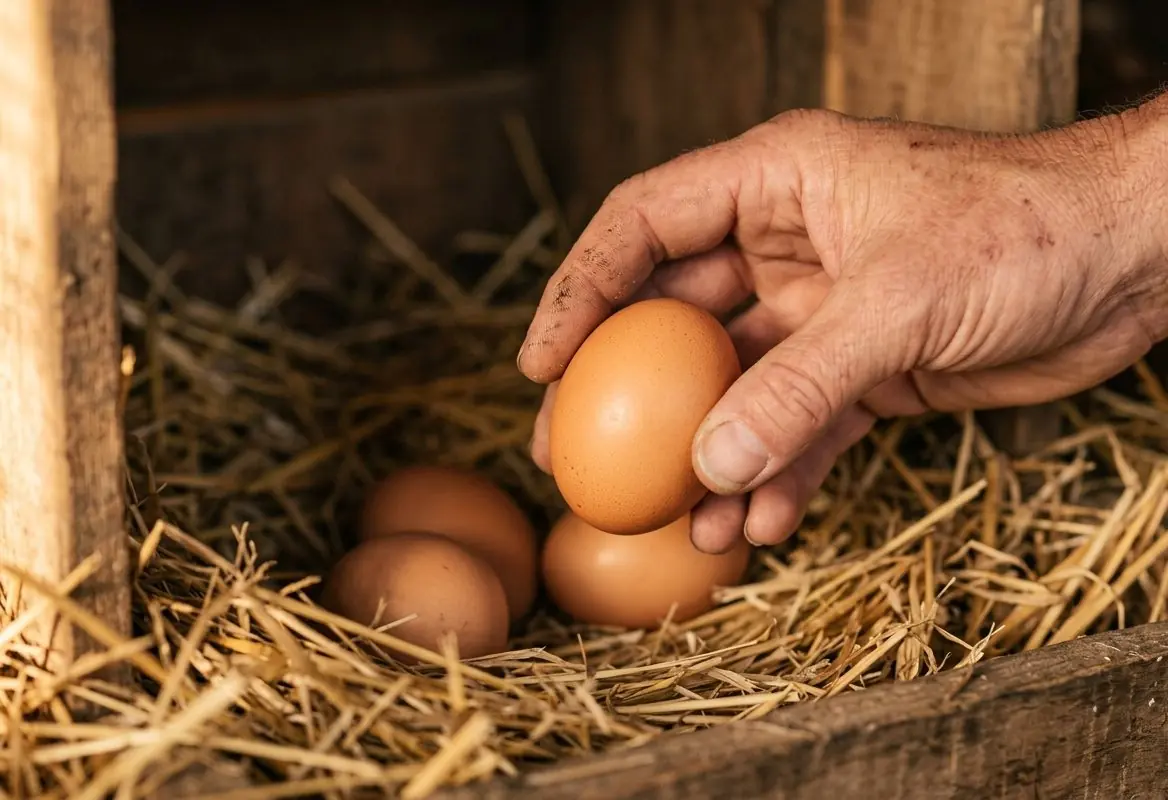
The honest answer to how to identify real desi eggs is that no kitchen test can prove it. Shell colour, size and yolk colour are set by breed, hen age and feed, and all three overlap between desi, crossbreed and farm hens. What helps is a set of signs read together: variation within the tray, a large yolk, a price that adds up and, above all, a seller who can describe the flock.
What does “desi” actually mean on an egg tray?
Less than buyers assume. The poultry advisory service at the University of Veterinary and Animal Sciences in Lahore describes the desi chicken as “non-descriptive” — a country bird often randomly crossed with Fayoumi, Aseel and Rhode Island Red. There is no pure desi breed standard to test an egg against.
Three things are sold under the name:
- Eggs from a mixed desi or desi-cross flock kept outdoors — a backyard or a free-range farm.
- Eggs from Golden, Misri or Golden Misri hens raised in sheds. Misri is the local name for the Fayoumi, an Egyptian breed; Golden is the Rhode Island Red. Classified listings advertise their eggs as desi; nobody has measured how common that is.
- Ordinary farm eggs dressed up — small commercial eggs, sometimes with the shell tinted brown.
Supply is the reason the second and third exist. A published study of Pakistan’s chicken sector, built on interviews with people across the industry, put backyard birds at 10–15% of the country’s chicken meat and eggs in its summary and 20–25% in its results section. The government’s Economic Survey 2025–26 is lower still for meat, putting rural poultry at about 5%. That is little against what the cities want to buy as desi anday. More on the two kinds in desi eggs vs farm eggs.
Is there a home test that proves an egg is desi?
No. Everything you can see or weigh at home overlaps between the three groups above. The university’s figures put desi-type eggs at 45–55 g, Misri at about 46 g and Golden at about 52 g; a kitchen scale cannot separate them.
Most tests that circulate for asli desi anday ki pehchan — the bowl of water, the thick white that stands up in the pan — are freshness tests, which a fresh farm egg passes as easily as a desi one. They are set out in how to tell if an egg is fresh. What follows are signs, not proofs.
How to identify real desi eggs: 7 checks that actually help
- Variation within the tray. This is reasoning rather than research: a mixed flock of different ages lays eggs that differ in size, shape and shade, while one commercial strain lays near-identical eggs, graded by weight. Thirty “desi” eggs that match exactly are a reason to ask.
- Shell texture and bloom. Washing damages the bloom, the thin natural coating on a newly laid egg, and an unwashed egg is often said to look matte, not glossy, though we found no study that tests it. An unwashed shell fits a small farm; it does not tell you the breed.
- Even, natural colour. Look for blotches, streaks or colour pooled in the pores, and wipe the shell with a damp cloth. Colour that comes away easily is suspicious, though nobody has validated this as a test and natural brown pigment can partly rub off too.
- Yolk-to-white ratio. The most breed-linked sign we know of inside the egg, though it also shifts with the hen’s age. Crack one beside a farm egg of similar size: a desi-type egg often carries a larger yolk and less white.
- Yolk colour, with caution. A deep yolk is evidence about feed, not breed, so count it only alongside the other signs.
- A price that adds up. A hen that lays little cannot produce a cheap egg. A “desi” dozen near the farm-egg price is very unlikely to be desi; a high price proves nothing.
- A seller who can describe the flock. Ask what birds are kept, how many, and whether you can visit. The only check about the hen rather than the egg, and worth more than the other six together.
| Sign | What it tells you | Weight |
|---|---|---|
| Mixed sizes, shapes and shades | A mixed flock | Moderate |
| Matte, unwashed-looking shell | Possibly not washed | Low |
| Blotchy colour, or colour that wipes off | Possible tinting | Suspicion only |
| Large yolk for the egg’s size | More likely desi-type or Misri-type than commercial | Moderate |
| Deep orange yolk | What the hen ate | Low |
| Price well above farm eggs | Fits low-output hens | Necessary, not sufficient |
| Seller can describe and show the flock | Traceability | Highest |
Are brown eggs always desi, and are desi eggs always brown?
No to both. Shell colour is set by the hen’s breed, and the American grading standards, for one, do not count it as a quality factor. Commercial brown-egg layers make brown pigment as well as any village hen.
It fails in the other direction too: indigenous fowl studied in eastern India laid shells from cream to light brown, and Misri eggs are white to off-white. So “brown means desi” is wrong, and so is “pale means fake”. The full argument is in brown eggs vs white eggs in Pakistan.
Do sellers really dye farm eggs with tea?
It has been reported, yes; fake desi eggs of this kind are in print, not only in rumour. A poultry trade journal reported in 2007, without naming the country, that traders were rolling small eggs discarded from commercial crates in warm tea water to brown the shell. A Lahore newspaper report from December 2019 described vendors staining farm eggs with chai patti to sell as desi. And in November 2025, food safety officials in Moradabad, India, seized about 81,000 eggs, more than 45,000 already coloured.
To be accurate, only the Lahore report is known to be from Pakistan; we found no comparable seizure on record here.
Does a dark yolk, a small egg or a better taste prove anything?
- Dark yolk. Hens cannot make yolk pigment; they deposit it from feed. Marigold extract is a standard feed additive, so a caged hen can lay a deep orange yolk and a free-ranging hen on poor ground a pale one.
- Small egg. Young hens of any breed, commercial layers included, lay noticeably smaller eggs at first.
- Taste. In a Pakistani study of six chicken genotypes, Aseel and Naked Neck among them, a trained panel gave ordinary White Leghorn eggs the highest scores for taste. Awkward for us to print, but it is the published result.
The yolk-to-white ratio holds up better. The same study found a significantly higher yolk share in Aseel, Naked Neck and Fayoumi eggs, and a Portuguese comparison found roughly 32–34% yolk in local-breed eggs against about 25% in a commercial hybrid. The catch: Misri eggs share the trait, so a big yolk argues against a commercial farm egg more than for a desi one. Golden hens went the other way in the Pakistani study, with the highest share of white.
What should real desi eggs cost in Islamabad?
Start with the hen. By the university’s figures a desi hen lays about 80–120 eggs a year, a Misri about 180 and a Golden about 200; a commercial layer manages close to 300. Mixed desi and desi-cross flocks fall in between, which is why other pages on this site quote roughly 140–180. Either way, each egg carries far more of the hen’s keep than a commercial egg.
No official rate list covers desi eggs. As of autumn 2026, price-tracking websites listed “desi” eggs in Islamabad at roughly Rs 480–520 a dozen against about Rs 240–280 for farm eggs, but those sites are unverified, disagree with each other, and do not say what hen is behind the label. That figure sits inside the band our guide to desi anday prices in Islamabad treats with suspicion. Farm-direct free-range desi eggs cost more, about Rs 600–700 in the few Islamabad listings we could check, and a “desi” dozen well under that deserves the questions that follow. All of it moves weekly and climbs in winter; current figures are on our desi egg price page.
What should you ask the seller?
The egg cannot tell you, so the seller has to. Whichever of the places that sell desi eggs in Islamabad you use, ask:
- What birds do you keep, and how many?
- Are they in a shed or on open ground during the day?
- What are they fed?
- How many eggs do you collect a day? At the lay rates above, a hundred desi hens average about 22 to 33 a day and a desi-cross flock nearer 40 to 50. A few dozen birds and unlimited trays means reselling.
- When were these laid?
- Can I come and see the birds?
For what it is worth, our own answers: a desi and desi-cross flock on open ground, eggs unwashed and delivered within 72 hours of laying, Rs 600 a dozen. We hold no certificates, so visitors are welcome — details are on the farm page.
The short version: nothing in your kitchen can prove an egg is desi. A mixed tray and a large yolk make it more likely; an unwashed shell fits a small farm but says nothing about the hen; a brown shell, a small size or a dark yolk mean very little; a price near the farm-egg rate makes it very unlikely. What settles it is a seller who can describe the hens and will let you go and look.
Try them yourself
Six-egg trial pack, Rs 300, delivered anywhere in Islamabad or Rawalpindi.