Where to Buy Desi Eggs in Islamabad: Every Option, Honestly Compared
Where to buy desi eggs in Islamabad: superstores, kiryana stores, WhatsApp sellers, farmers markets and farm delivery compared on price, freshness and proof.
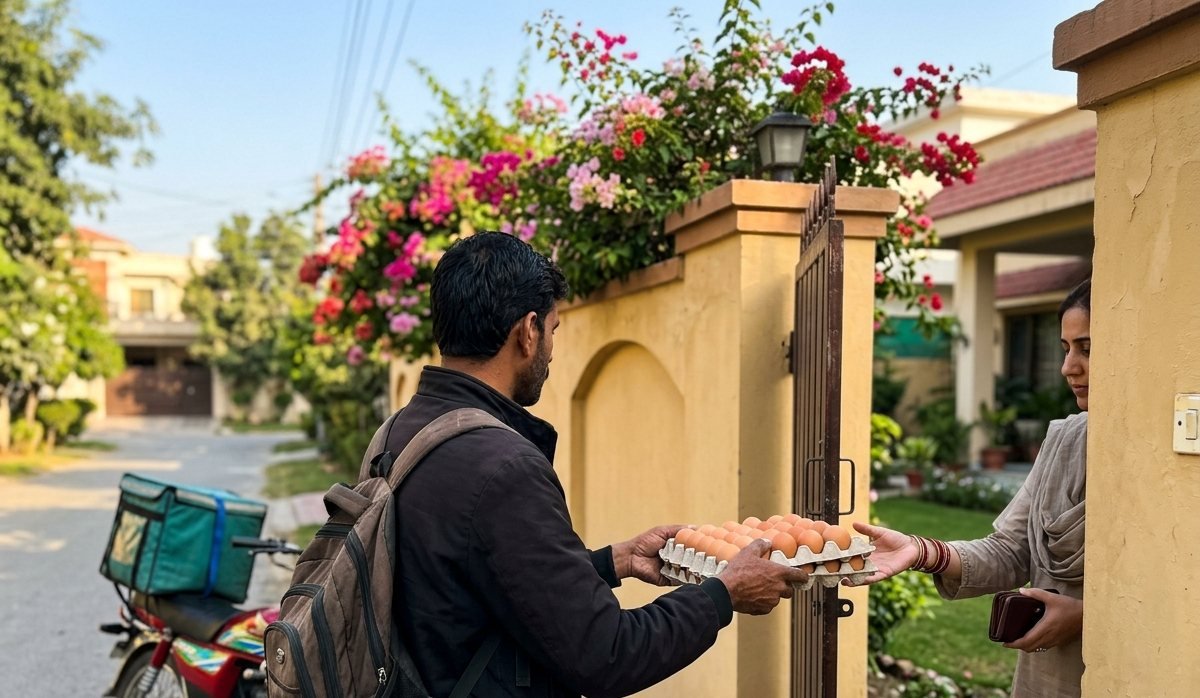
In Islamabad and Rawalpindi, desi eggs are sold through five channels: superstores and grocery chains, neighbourhood kiryana stores, home sellers on Facebook and WhatsApp, weekend farmers markets, and farms that deliver direct. Genuine free-range desi eggs from Islamabad farms cost Rs 600–750 a dozen in 2026; a carton priced much below that is usually a brown commercial egg wearing the wrong name. The channels differ less on price than on two things — how old the egg is when it reaches you, and whether you can check the desi claim at all.
Why do desi eggs cost Rs 600–750 a dozen in the first place?
Because the hen lays half as many eggs. A desi or desi-cross hen with outdoor access lays roughly 140–180 eggs a year, while a caged commercial layer lays close to 300. Fewer eggs from a bird that also needs ground to walk on means each egg carries more cost, and the retail ladder follows: white commercial eggs sit around Rs 250–300 a dozen in Islamabad, brown commercial eggs around Rs 400, and free-range desi eggs from local farms at Rs 600–750. The full breakdown is in what desi eggs cost in Islamabad; what matters for this article is the middle of that ladder. An egg labelled desi but priced at Rs 400 is priced like a brown commercial egg, and it usually is one.
What do superstores actually sell as “desi”?
The superstore is the most convenient channel by a distance — long hours, air conditioning, card payment, a receipt — and the least verifiable. You see a carton and a word. Cartons labelled desi in the chains typically sit somewhere between the brown commercial price and the farm rate, and much of what fills them is brown commercial: uniform in size, uniform in shade, laid by the same high-yield breeds as the white eggs one shelf over. Shell colour is set by breed alone, so a brown shell proves nothing about how the hen lived — the pattern is covered properly in desi eggs vs farm eggs.
Freshness is the other quiet cost. A supermarket egg travels from farm to packer to distribution centre to shelf, and most cartons in Pakistan carry no lay date, so there is no way to know where in that journey your carton sits. By the time it reaches your kitchen it is typically one to three weeks old — still safe, but past its best for poaching or frying, where a fresh egg holds together and an old one spreads.
The neighbourhood kiryana store
The kiryana is the second most convenient channel and the most honest about its own ignorance. Eggs are usually loose, sold per egg; where a shop keeps claimed desi eggs at all, they tend to run Rs 50–60 apiece, which matches the Rs 600–750 dozen rate. Ask the shopkeeper where they come from and you will generally get a straight answer: a supplier brings them, and the supplier said desi. That is not dishonesty — it is distance. By the time an egg has passed through a wholesaler and a delivery van, its origin is a rumour.
Freshness depends on turnover, and loose eggs sit unrefrigerated, so age varies from days to weeks between shops and between visits. The compensations are real: the kiryana is two streets away, open at 10 pm, and happy to sell you three eggs. If you buy there, the four freshness tests are worth knowing, because the shop cannot run them for you.
Are Facebook and WhatsApp home sellers reliable?
Sometimes, and that is the problem — you cannot tell which sometimes you are in. The typical home seller keeps a small household flock and sells the surplus at Rs 600–750 a dozen, often genuinely fresh, sometimes only days from lay. When it is good, this channel is very good.
The failure mode is variation. A flock of ten or fifteen hens does not lay evenly through the year; birds moult, winter slows them, demand outruns supply. Some sellers pause and say so. Others quietly top up from the wholesale market to keep their customers, and the egg you were sent in week one is not the egg you receive in week six. There is no storefront, no recourse, and usually no way to visit. Verification is a photograph and a promise, and a photograph of hens proves that hens were photographed. The only reliable filter is time: after months as a customer you will know what you have found.
Weekend farmers markets
The markets that run on weekend mornings in Islamabad put you face to face with the seller, which is worth something: you can ask how many birds they keep, what the birds eat, and when the eggs were laid, and watch how the answers land. The questions worth asking any egg seller apply here word for word. Prices sit at the usual Rs 600–750, sometimes above it.
The limits are practical and structural. Practically: one morning a week, one location, and the good stalls sell out early. Structurally: not every stall is a farmer. Some are traders who buy the same wholesale brown eggs available to any shop and arrange them in rustic baskets. A table at a market proves the seller got up early, not that they keep hens. Face to face is better than a carton, but it is still testimony, not evidence.
Buying direct from a farm that delivers
Several small farms around Islamabad and Rawalpindi now take orders on WhatsApp and deliver to the door. On price this channel is no cheaper — the same Rs 600–750 a dozen, usually with a delivery charge on top. On freshness it is generally the strongest, because a farm selling its own lay has the shortest possible chain: the egg goes from the shed to a tray to your kitchen, often within days.
On verification it is the only channel where checking is even possible, because a farm has an address and birds that are either there or not. The filter is a single question: can I come and see the hens? A farm that says yes may still be ordinary, but it is not hiding anything. A farm that hedges has answered a different question. A polished page and the word “farm” are cheap online — middlemen use both — which is why the visit question does the work no label can.
The honest drawbacks: you order a day ahead rather than lifting a carton off a shelf, small farms cap orders or run waiting lists because 140–180 eggs a year per hen is a hard ceiling, and the delivery fee stings on small orders.
How do the five channels compare?
| Channel | Typical price, dozen | Age when bought | Can you verify the claim? | Main failure mode |
|---|---|---|---|---|
| Superstore or chain | Rs 400–750 | Often 1–3 weeks | No — a carton and a word | “Desi” is often brown commercial |
| Kiryana store | Rs 600–720 loose | Unknown, varies by turnover | No — shopkeeper repeats the supplier | Origin lost in the supply chain |
| Facebook or WhatsApp seller | Rs 600–750 | Often days, when honest | Rarely — photos and trust | Quality varies week to week |
| Weekend farmers market | Rs 600–750 and up | Usually under a week | Partly — you can question the seller | Some stalls are resellers |
| Farm that delivers | Rs 600–750 plus delivery | Often 1–4 days | Yes — you can visit | Needs planning; supply is capped |
When is a channel other than a farm the sensible choice?
Often. If the eggs are going into a cake, a biryani, or anything where the egg is an ingredient rather than the dish, the white commercial egg at Rs 250–300 a dozen is honestly fine, and paying Rs 600 to bury a desi egg in batter is a waste of the difference. If it is 10 pm and breakfast needs eggs, the kiryana is the answer and no farm will beat it. If you enjoy the weekend market and have learned which stalls are farmers, that habit is worth keeping. The farm channel earns its case in one situation only: when you are deliberately paying the desi rate and want the thing you are paying for to be real.
The only claim you can check with your own eyes
Every channel above ends in the same place — someone telling you an egg is desi. The carton says so, the shopkeeper’s supplier said so, the seller’s photos say so, the stallholder says so. In a market with no enforced certification, the only version of “desi” you can confirm yourself is a farm that lets you walk in and look: birds on the ground, in daylight, in numbers that match what the farm claims to sell.
That is the standard we think buyers should hold every farm to, including ours. Barakaat Farms keeps an open gate — anyone can visit the farm before or after ordering, and pickup from the gate is free. For those who would rather not drive, we deliver across Islamabad and Rawalpindi. But the point stands wherever you buy: whichever farm you choose, ask to see the hens. The question costs nothing, offends no honest farmer, and settles more than any label ever will.
Try them yourself
Six-egg trial pack, Rs 300, delivered anywhere in Islamabad or Rawalpindi.