Desi Chicken Karahi: The Recipe, and Why the Bird Decides It
A complete desi chicken karahi recipe for one desi cockerel: ingredients, step timings, and the 40-60 minute covered simmer that stops it turning out tough.
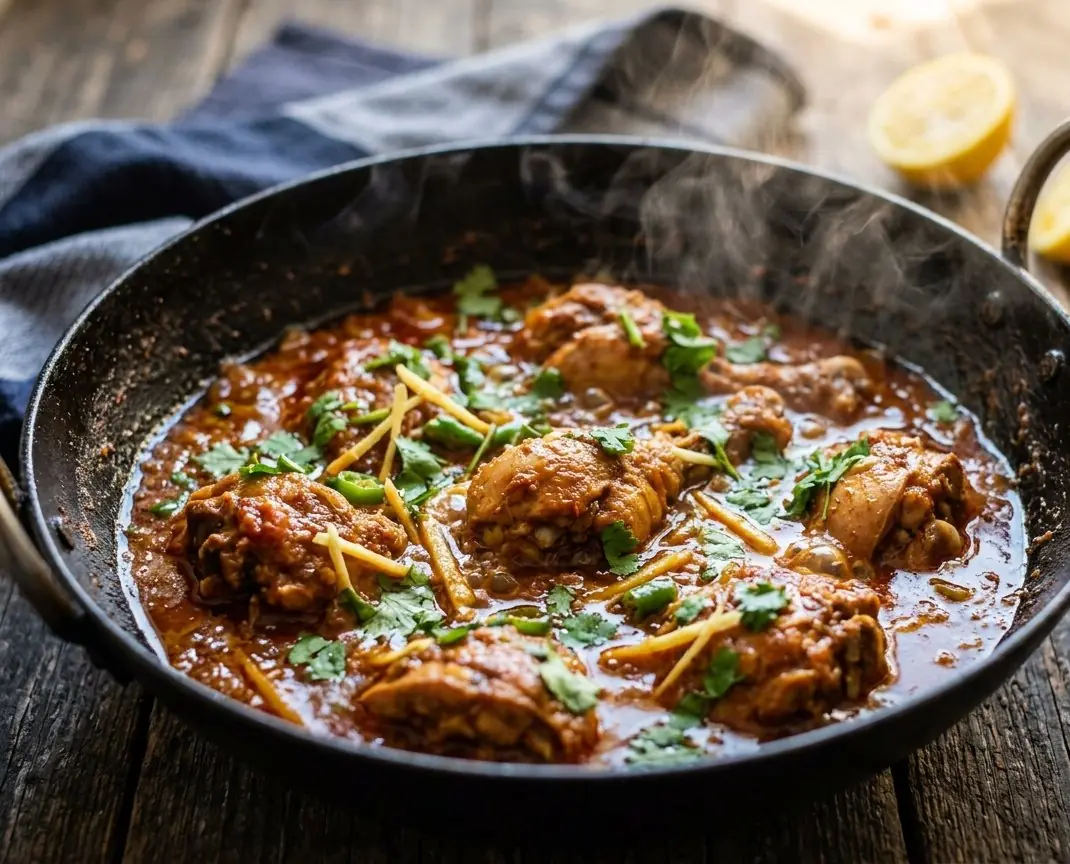
A desi chicken karahi uses the same short ingredient list as any Pakistani karahi — tomatoes, ginger, garlic, green chillies, salt and fat — but the bird changes the method. A desi cockerel of 1 to 1.25 kg dressed needs a covered simmer of roughly 40 to 60 minutes until tender before the high-heat bhunai, while a broiler goes straight into the open karahi. Skipping that simmer stage is the single most common reason desi karahi comes out tough at home.
Why does desi karahi come out chewy at home?
Because almost every karahi recipe in circulation was written for a broiler, and a desi cockerel is a different animal. A broiler reaches slaughter weight in about 6 weeks and has barely used its muscles; a desi cockerel takes 4 to 6 months and has spent that time walking, scratching and flapping. That working life is where the flavour comes from, but it also builds connective tissue — collagen — through the legs, thighs and wings. Collagen only softens into gelatine with time and moisture. Give it 40 to 60 minutes in simmering liquid and it melts, carrying the meat with it. Hit it with high, dry karahi heat straight away and it tightens instead, which is the chew people blame on the bird.
The bird is not the problem. The method is. A broiler recipe applied to a desi bird fails every time, for the same reason a steak recipe applied to a shank fails: the cut decides the cooking, not the cook.
What do you need for a one-bird desi karahi?
Karahi is deliberately a short list. The tomatoes, ginger and green chilli do the work; there is no onion and no garam masala in the classic version, and it does not miss them. For one desi cockerel of 1 to 1.25 kg dressed, serving 4 to 5 people with roti:
- One desi cockerel, 1 to 1.25 kg dressed, cut into 12 or 16 pieces (more on the cut below)
- Ripe tomatoes, roughly equal in weight to the bird — about 1 kg
- One head of garlic, 8 to 10 cloves, crushed
- Two thumb-sized pieces of ginger: one crushed for the pot, one cut into fine matchsticks for finishing
- 6 to 10 green chillies, slit, to your tolerance
- 150 to 200 ml oil or ghee (use the lower end if cooking skin-on, since the skin renders its own fat)
- 1.5 teaspoons salt, adjusted at the end
- 1 teaspoon crushed cumin, 1 teaspoon crushed coriander seed, half a teaspoon coarse black pepper
- A handful of fresh coriander
- About 500 ml water for the simmer stage — the one ingredient a broiler karahi never needs
How do you cook desi chicken karahi, step by step?
- Brown the bird — 6 to 8 minutes. Heat the oil in a karahi or heavy pot over high heat and sear the pieces until the surfaces are sealed and lightly golden. Do this in two batches if the pot is crowded.
- Add garlic and crushed ginger — 2 minutes. Stir until the raw smell goes. Do not let the garlic darken.
- Add the tomatoes and salt — 5 minutes. Cook on high until the tomatoes start to slump and release their juice.
- Add the water and cover — 40 to 60 minutes. Pour in about 500 ml, bring to a boil, then drop the heat to low and put the lid on. This is the stage that decides the dish. Check at 40 minutes: a knife should slip into the thickest thigh piece with little resistance. A younger bird of around 1 kg is usually tender at 40 to 45 minutes; a fuller 1.25 kg cockerel can want the whole hour.
- Uncover and raise the heat — 10 to 15 minutes. This is the bhunai. Boil hard, stirring and scraping, until the liquid reduces, the tomatoes break down completely and the oil separates and pools at the edges. The gravy should cling to the meat, not sit under it.
- Add the dry spices and chillies — last 5 minutes. Cumin, coriander seed and the green chillies go in near the end so they stay bright rather than stewed.
- Finish off the heat. Scatter the ginger matchsticks, black pepper and fresh coriander, put the lid back on and rest it for 5 minutes before serving.
Total time is about 75 to 95 minutes, of which the long middle stage is unattended. A broiler karahi, for comparison, is a 35 to 45 minute dish from first sizzle to table.
Open pot or pressure cooker?
The pressure cooker is a legitimate shortcut, not a cheat. Brown the bird, cook the garlic, ginger and tomatoes as above, add one cup of water, then pressure-cook for 15 to 20 minutes at full pressure in place of the 40 to 60 minute simmer. Release, transfer everything to the karahi and do the high-heat bhunai in the open as normal. It saves half an hour or more.
The open pot keeps one advantage: control. You can test the meat as it goes and stop exactly at tender. Under pressure you are guessing, and an extra five minutes can take a desi bird from tender to falling apart, which eats fine but loses the firm bite that is half the point of buying desi in the first place. With a desi bird, check at 15 minutes the first time. Either way, the sequence is fixed: tenderise first, then the dry heat. The order is the recipe.
| Stage | Desi cockerel | Broiler |
|---|---|---|
| Browning | 6–8 minutes | 5–6 minutes |
| Covered simmer | 40–60 minutes in 500 ml water | None — skip straight to bhunai |
| High-heat bhunai | 10–15 minutes | 15–20 minutes |
| Total | 75–95 minutes | 35–45 minutes |
Skin on or skin off?
Traditional karahi is made skinless, and for a first attempt that is the sensible choice. Desi skin is thinner than broiler skin with less fat under it, and in a karahi it either renders into the gravy — adding a deeper, almost yakhni-like body — or stays slightly chewy if the bhunai does not get hot enough to deal with it. Skin-on rewards confident, hard heat at the end; skinless is forgiving everywhere.
We sell the whole desi chicken at Rs 2,650 per dressed bird in any cut, and skin-on costs Rs 300 more — not because skin is a luxury, but because hand-plucking a bird without skinning it takes meaningfully longer. If you are not sure you want the skin, do not pay for it. Most karahi cooks will not miss it.
Which cut should you ask for?
Ask for 16 pieces for karahi, or 12 if you prefer recognisable joints. On a 1 to 1.25 kg bird, 16 pieces are small enough to cook evenly through the simmer and give the masala more surface to cling to during the bhunai. Larger cuts — 8 pieces or a whole bird — suit roasting, or the long wet cooking of a desi murgi yakhni, where an older hen and big joints are an advantage. Karahi wants the cockerel; yakhni wants the hen. They are different birds for different pots, which is why we ask which dish you are cooking before cutting.
One planning note: a desi karahi is a decided meal, not an impulse one. Whole chicken orders close at 8pm, the bird is hand-slaughtered halal to order the next morning and delivered chilled that day — so the karahi you are reading about now is realistically tomorrow’s dinner, not tonight’s.
When is a broiler karahi the better choice?
Honestly: often. If it is a weeknight and dinner needs to be on the table in 45 minutes, the broiler wins on time alone — 35 to 45 minutes against 75 to 95. If you are feeding eight people and the karahi is one of three dishes, the broiler wins on cost too: broiler meat currently runs around Rs 455 to 520 per kg, so a generous broiler karahi costs well under half of a Rs 2,650 desi bird. There is no shame in that maths, and anyone who tells you a broiler cannot make a respectable karahi is selling something.
The desi bird earns its place when the chicken is the point of the meal: the flavour is deeper, the bite is firmer, and the gravy picks up a stock-like richness from the gelatine that a 6-week broiler simply has not had time to build. The full comparison — texture, cooking behaviour, when each makes sense — is in desi murgi vs broiler, and current market rates for desi birds are in the desi murgi price guide. The short version: a desi karahi cooked properly is better eating than a broiler karahi, but a desi karahi cooked like a broiler karahi is worse than one. If tonight is a 40-minute night, buy the broiler and cook it well.
One last practical point in the desi column: leftovers. The gelatine-rich gravy sets overnight and reheats gently with a splash of water into something arguably better than the first serving. Broiler karahi, generally, does not improve on day two. Plan the desi bird for a weekend when there is time for the simmer — and let the simmer, not the masala, do the work.
Try them yourself
Six-egg trial pack, Rs 300, delivered anywhere in Islamabad or Rawalpindi.