Egg Rate Today in Islamabad and Rawalpindi: How the Daily Rate Actually Works
Egg rate today in Islamabad and Rawalpindi explained: how the daily farmi egg rate is set, why shops differ, and why no real desi egg rate exists.
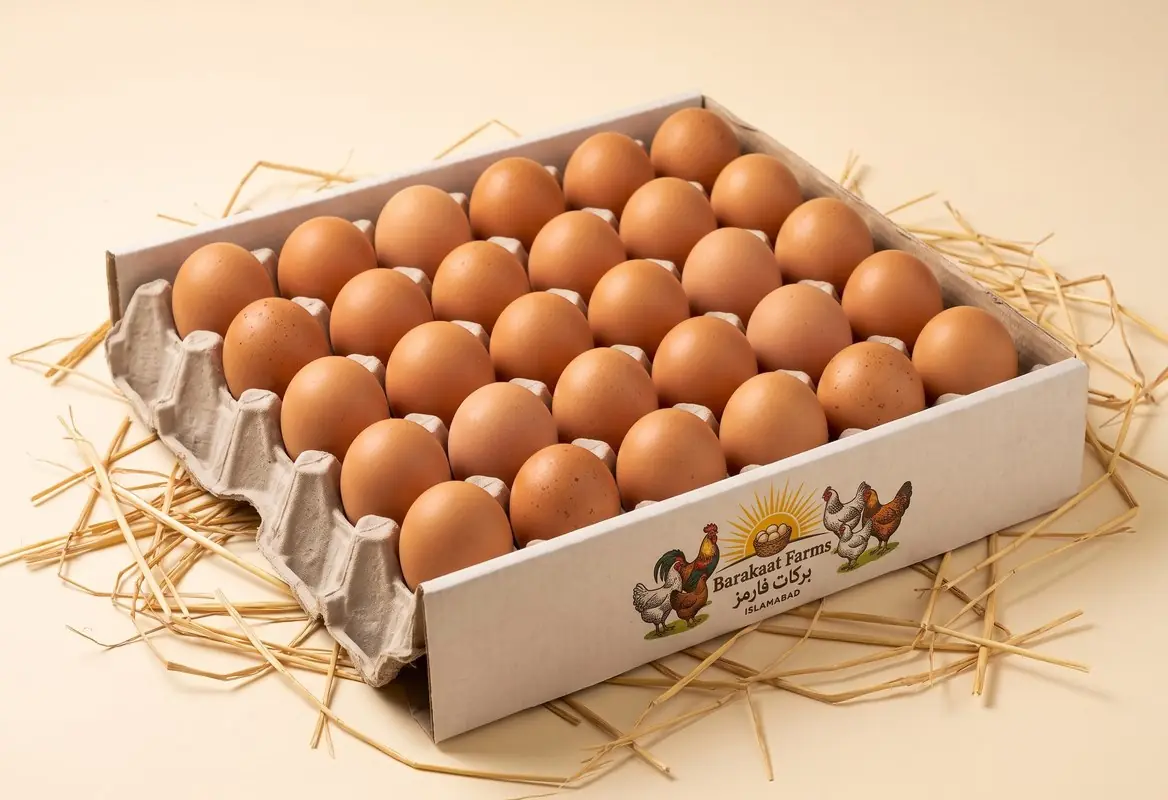
The “egg rate today” in Islamabad and Rawalpindi is a wholesale number for commercial (farmi) eggs, set each morning where large farms, wholesalers and retailers trade — no shop fixes it, and it changes daily. At retail, white farmi eggs generally sit somewhere around Rs 250–300 a dozen, moving with season and supply. Desi eggs are not on that rate sheet at all: they are priced individually by each farm and change rarely, with Islamabad-area listings mostly between Rs 600 and Rs 700 a dozen.
That short answer hides a system. The system explains why the number moves every day, why two shops on the same street quote different prices on the same morning, and why nobody can honestly publish a “desi egg rate today”.
Why is there a daily rate for farmi eggs at all?
Commercial eggs behave like a commodity, and commodities get daily prices. Three conditions make that possible, and farmi eggs meet all three.
- Huge, standardised supply. Commercial layer farms keep thousands of birds of the same breed on the same feed, and a caged commercial layer produces close to 300 eggs a year — roughly double what a free-range desi hen manages. The output is millions of near-identical white eggs. One tray is interchangeable with another, which is exactly what a traded commodity requires.
- Perishability. Eggs cannot sit in a godown waiting for a better price the way grain can. Supply has to clear quickly, so sellers accept what the market pays today rather than hold stock and watch it age.
- Bulk trading. Farmi eggs move in trays of 30 and crates of hundreds, from farm to wholesaler to retailer. When that much identical product changes hands every morning, a single clearing price emerges on its own.
Put together: a large, uniform, perishable supply traded in bulk produces a price that has to be rediscovered every day. That rediscovered price is the rate people search for each morning.
How is the egg rate set each morning?
In general terms, the day’s rate comes out of wholesale trade, not out of any office. Large farms and their agents offer the morning’s stock; wholesalers bid based on what retailers have ordered and how much of yesterday’s stock is still moving; the price at which most trays actually change hands becomes that day’s wholesale rate for the city. Rate sheets then circulate through the trade by phone and messaging groups, typically quoting a per-dozen or per-tray wholesale figure.
The rate reacts to the usual commodity inputs. Feed typically makes up the largest share of a commercial farm’s cost, so when feed prices move, the egg rate generally follows within weeks. Weather and season matter too: heat and cold both affect how reliably hens lay, and colder months pull more eggs into kitchens.
Two details are worth holding onto when reading any rate sheet. First, the published rate is a wholesale number — the price a shopkeeper pays, not the price a customer pays. Second, it varies by city, because feed costs, transport distance and local demand differ. Islamabad and Rawalpindi usually track each other closely since they share one supply chain, but neither is obliged to match Lahore or Karachi on any given day.
Why do two shops on the same street quote different prices?
Because the daily rate is where a shop’s costs start, not where its prices end. Each shop adds its own margin to cover rent, breakage and transport, and no rule says those margins must match. Shops also restock on different days: one may still be selling trays bought at yesterday’s lower rate while its neighbour restocked at this morning’s higher one. Larger shops buying in volume often pay a little less per tray than a corner store, and most counters round to clean figures rather than pass on every small movement in the sheet.
So on any given morning, two shops a minute apart can both be quoting honestly and still differ on the same dozen. Neither is cheating; they are standing at different points in the same supply chain.
What is the farmi egg rate today in Islamabad and Rawalpindi?
No honest page can print a single figure here and stay correct, because the number changes daily — which is rather the point of this article. What can be said is this: in recent months, white farmi eggs at retail in the twin cities have generally sat in the region of Rs 250–300 a dozen, with the lower end more typical of warm months and the upper end, sometimes beyond it, showing up in winter. For today’s exact figure, the counter of any general store is more current than any website, including this one.
Why does the whole rate sheet climb in winter?
Winter squeezes both sides of the equation at once. Demand rises, because eggs are widely treated as warming food across Pakistan and households simply buy more of them. Supply dips, because hens typically lay less in cold weather and shorter daylight. The daily rate translates that squeeze straight into higher numbers through the colder months. The full mechanics — including why desi eggs feel the winter squeeze even harder than farmi — are covered in why egg prices rise in winter in Pakistan.
Is there a “desi egg rate today”?
No. There is no official daily rate for desi eggs in Islamabad, Rawalpindi or anywhere else in Pakistan — any website publishing a “desi egg rate today” is guessing. That claim is worth stating plainly, because the phrase is searched every morning and a handful of pages are happy to put a number on it anyway.
The reason no real rate exists is the farmi system in reverse. Every condition that creates a daily rate fails for desi eggs:
- Supply is tiny. A free-range desi hen lays roughly 140–180 eggs a year against close to 300 for a caged commercial layer, and desi flocks are small — dozens or a few hundred birds, not tens of thousands. There is no bulk volume to trade.
- Nothing is standardised. Desi eggs vary in size, shell colour and yolk from bird to bird and season to season. One farm’s tray is not interchangeable with another’s, so no single price can speak for all of them.
- They are sold direct. Most desi eggs travel straight from farm to household — WhatsApp orders, farm pickup, word of mouth. They rarely pass through the wholesale market where rates are made.
So each farm sets its own price and holds it, usually for months at a stretch. In the Islamabad listings we could check, free-range desi eggs cluster around Rs 600–700 a dozen — roughly double the farmi band, for reasons broken down in the desi anday price guide for Islamabad. The honest version of a “desi rate” is a range and a date, not a daily number.
Then where do the published “desi rates” come from?
Generally one of two places: pages copying each other’s figure until it looks official, or pages taking the farmi rate and adding a markup. Neither reflects an actual market, because no desi wholesale market exists to generate one. A more useful habit than searching for the rate is judging the eggs themselves — how to identify real desi eggs covers the checks — and comparing farms’ published prices directly, since those are the only real desi prices there are.
What does a stable farm price mean for a buyer?
Mostly, it means the price risk moves from the buyer to the farm. With farmi eggs, the daily rate passes every cost shock to the customer within a day or two. A desi farm with a published price absorbs those shocks until it deliberately revises the figure — which tends to happen a few times a year, not every morning. The trade-off runs the other way too: when the farmi rate dips in summer, the desi price does not follow it down.
| Question | Farmi (commercial) eggs | Desi eggs |
|---|---|---|
| Who sets the price | The wholesale market, daily | Each farm, individually |
| How often it changes | Every day | Rarely — a few times a year |
| Typical retail in the twin cities | Roughly Rs 250–300 a dozen | About Rs 600–700 a dozen in checked listings |
| Where to check it | The shop counter, this morning | The farm’s own published price list |
Our own pricing works the stable way. A dozen desi eggs from our farm is Rs 600 — one published figure, the same in January as in June, listed in full on our desi eggs price page. If costs ever force a change, the published price changes and then stays put; there is no daily number to track. Orders placed before noon are delivered the same day across Islamabad and Rawalpindi, and later orders arrive the next day, so the price seen when ordering is the price at the door.
The practical rule of thumb, then. For farmi eggs, skip the websites and ask the shop — only the counter knows today’s number. For desi eggs, be suspicious of anyone quoting a “rate today”, and compare actual published farm prices instead; where to buy desi eggs in Islamabad lists the sensible places to look. One of those numbers is built to move every morning; the other is supposed to stand still.
Try them yourself
Six-egg trial pack, Rs 300, delivered anywhere in Islamabad or Rawalpindi.